


The original article was written in German and posted on LinkedIn. But it aged well and I honestly feel like it has been some of my better writing until now so I translated it to republish it
.
Agility is, without question, still a top contender in the category of “buzzwords everyone uses without having understood the principles behind them.” As a result, the term’s impact is steadily eroding, and the actual core of agile leadership principles gets dismissed as hype. That is unfortunate, because these principles are meant to provide orientation for how to act effectively in a context defined by uncertainty. You know—VUCA.
The hype is driven by consultants. They now call themselves Agile Coaches and keep armies of people busy sticking Post-its to digital and analog walls. The marketing mistake made by this personified version of agility is obvious: it tries to sell supposedly new principles through new people and new methods. Not exactly a strong foundation for credibility. And this is not about resistance to change or a lack of insight that the world is changing. It is far more a matter of scientific skepticism: principles that claim a certain degree of general validity should be based on a much broader body of evidence than software development and companies from Silicon Valley. That is a legitimate objection.
The tragedy is this: there is far more evidence that agile principles do have general validity. People just don’t talk about it, because some advocates, riding on the coattails of agility, insist on smuggling in New Work utopias such as the abolition of hierarchy and universal individual self-actualization.
Take the Japanese in the 1970s. A textbook example of hierarchical conformity. As early as 1986, Hirotaka Takeuchi and Ikujiro Nonaka published the article “The New New Product Development Game,” describing how Japanese companies in the 1970s developed products quickly and flexibly that matched the spirit of the time. The word agility does not appear, but the authors describe the conflict that sequential planning in the sense of the waterfall model is incompatible with the speed and flexibility demanded by markets. And we are talking about cameras, printers, and cars—products that still have comparatively long life cycles. They conclude that companies are successful in developing new products when they:
have a clear goal
build interdisciplinary, autonomous teams
follow an iterative process that fosters learning and enables rapid adaptation
This sounds very much like the standard demands of any agile transformation. Not by coincidence, Japan established its dominance in the electronics and automotive industries during this period. Part of this was later successfully imported into Europe in the form of Kaizen (learning through iteration) and Lean Production (shared responsibility for quality and process improvement). The continuous improvement process should still be familiar to every employee in a manufacturing corporation today.
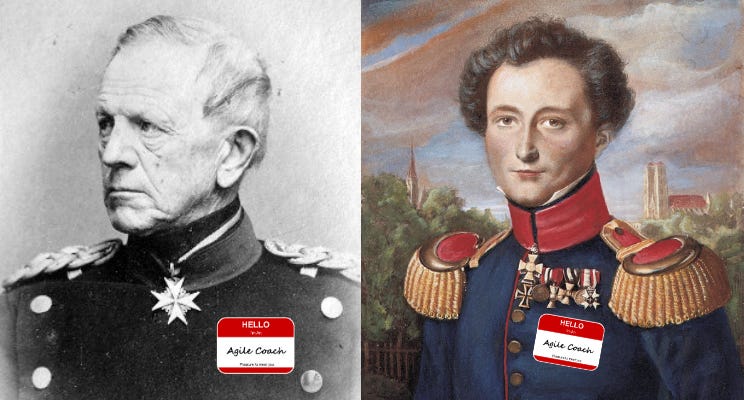
But it gets even more extreme. The absolute antichrist of the agile hipster: the Prussian military. Uniformity, obedience, and discipline combined with a strict hierarchy - I can hardly imagine a better nemesis. And yet I claim: Carl von Clausewitz and Helmuth von Moltke are the real godfathers of agile leadership.
In his magnum opus On War (circa 1832), Carl von Clausewitz writes that one can never truly be certain of one’s “knowledge of the enemy and his country, which forms the basis of all our ideas and actions.” “Consider the nature of this basis,” Clausewitz continues, “its unreliability and variability, and one will soon sense how dangerous the edifice of war is, how easily it can collapse and bury us beneath its ruins. […] A large part of the information one receives in war is contradictory, an even larger part is false, and by far the greatest part is subject to considerable uncertainty.” “Three quarters of the factors on which action in war is based are shrouded in a fog of greater or lesser uncertainty.”
Yes, even in the 19th century, war was highly VUCA. Instead of an acronym, the metaphor was “the fog of war.” The challenge then, as now, is that we do not know what lies ahead of us. So how do we deal with it? Hemut von Moltke, a successor in thought of Clauswitz - also declares the waterfall model obsolete, because “only the layman believes that in the course of a campaign he can discern the consistent execution of a preconceived plan, worked out in every detail and adhered to until the end.” In reality, the approach was usually far more agile. The objectives remain the same, “but the paths by which [the general] hopes to reach them can never be determined with certainty far in advance. Throughout the entire campaign he is dependent on making a series of decisions based on situations that cannot be foreseen.” Moltke is, in effect, defending every product manager who once again has to explain why the current roadmap is non-binding.
The challenge, Moltke continues, is “to correctly assess what is given, to guess what is unknown, to make a decision quickly, and then to carry it out forcefully and without hesitation.” Eric Ries would say: generate hypotheses based on data and rapidly and decisively test their assumptions through experiments. I am grateful that my product decisions usually do not entail gambling with the lifes of people, but if this idea holds up in truely existential circumstances, then it must be true for the release of web app.
“As a result of these ideas, the principle of mission command was developed, following a clear logic: because a superior can never fully oversee everything happening on the battlefield, foresee all contingencies in detail, or directly influence the actions of his troops, only the objective to be achieved is specified to the subordinate, while the details of execution are left to him. Thanks to the resulting strengthening of personal responsibility at lower levels of command, rapid and decisive action is possible even in unclear situations.” (Bühlmann & Braun, 2010)
Clear goals and autonomy in execution in order to respond flexibly to changing conditions—this is exactly where we find the principles of agile leadership that we are so quick to dismiss today as a modern hype. And the Prussian military was highly successful with this approach. Not only under Helmuth von Moltke in the three wars of German unification, but also in the subsequent world wars, extraordinary military achievements were accomplished on the basis of mission command. It is no coincidence that mission command is still considered best practice worldwide today, especially among elite units.
I understand the reflex not to want to learn from war and the military. Killing and destruction do not fit into a humanitarian worldview. And in the circle of chairs where we are supposed to practice nonviolent communication together, associations with Prussian officers and generals are of limited help. Nevertheless, we should acknowledge that the principles of agile leadership do not work only in the context of mate-drinking millennials in Berlin building the next dating app. These principles have proven themselves for more than 100 years in a wide range of dynamic environments.
Detached from the often annoying methods and the agile snake-oil salesmen, we can accept that these “hyped” principles have always been the foundation of good leadership. Maybe the coaches should really try wearing a spiked helmet (German: Picklhaube) and build a bridge to the virtues of the eternally conservative. That might even convince them of the proven principles of agile leadership.